Sparkly Rainbow Unicorn and Other Energies

The dizziness came first, and then the darkness, edging in from my peripheral vision.
One minute, I was walking through Nichols Park, feeling fine. The next, my knees went weak as I started to faint. I was next to a park bench and collapsed onto it, head between my knees.
I sat there with my head down, letting the nausea pass and the dizziness subside. Once it did, I looked up and I could see all the beautiful fall colors of the leaves.
It was May.
I blinked. Still there.
It wasn’t just fall leaves. Some plants were blindingly bright, deep red and burnt orange. The grass hummed soft and low. There was a shimmer to the edges of things, as if the world was gently vibrating.
It was beautiful, and for a moment I felt only wonder.
Then my thoughts intruded.
Oh God. I have a brain tumor. I was 21, and tended toward drama.
But then I heard a quieter voice, one that didn’t speak from fear. Calm down. You’ve seen this before.
And I had. I had seen it before, and I had sent it away.
In graduate school, I had made myself serious. I read difficult books and wrote difficult things. I learned to lean into logic, to sharpen my mind and focus my arguments. There was no room in that Celia for color spilling from trees, for energy humming through roots. I had dismissed it long ago, told myself it didn’t fit into the person I was becoming.
And yet, here it was. Again.
Why now? I wondered.
Nearly twenty years later, I would learn about the sun allergy. How my body buckled under the light. I realized how the dizziness that day cracked open something I had shut away. But at that time, I only knew that I was seeing something I had long ago chosen not to see.
And then another memory surfaced.
I was 11, attending a piano clinic, working one-on-one with a distinguished pianist. He was blind.
At the end of our session, he turned to me. “Go ahead and ask.”
I hesitated. “Excuse me, sir?”
“Ask what you want to ask. I won’t take offense.”
I thought for a moment. “I know that there are braille scores, but do you really learn new pieces that way?”
“Rarely,” he said. “Mostly I learn by ear.”
I nodded, impressed. “That’s amazing, sir,” I said.
“It’s not as impressive as it seems,” he said. “I have synesthesia. Do you know what that is?”
“No, I’ve never heard of it.”
“It means that my brain is cross-wired. When I hear a note, I see a color.”
I thought about that. “Is it a special type of perfect pitch?” I asked.
“It includes perfect pitch, but it’s more than that.”
“Does music look like pictures to you?” I asked.
“Sort of,” he answered. “Being blind, my idea of pictures is no doubt different from yours.”
I turned this over in my mind. “Do you think you have it because you’re blind?”
“Maybe,” he said, “but I’ve had it as long as I can remember. So maybe not.”
I hesitated. “Do you see colors for other things? Things that aren’t music?”
“Yes, sometimes, if I choose.”
I paused. “Can you see me then?”
He tilted his head, considering. “I can see the colors around you.”
He waited a moment, an extra beat, then asked, “Can you?”
I started to say no, but then I looked at him, waiting. He had seen me, recognized me, despite his blindness.
“Yes, sir,” I said. “Sometimes.”
He nodded. “I thought you might.” Then he said, reassuring me, “It’s nothing to worry about. It’s just how some of us are wired. It means we see things differently, that’s all. Synesthesia. Remember it.”
I didn’t, not for a long time. But it was there, in my memory, when I needed it: a neurological explanation for my sensory experience.
Synesthesia.
What Science Knows About Auras, Intuition, and Sensory Perception
Some people see colors around things. Others feel shifts in a room before anyone speaks. Some just know—before it happens.
We use words like intuition, energy, and sometimes psychic to describe these experiences. Science uses different language—and it doesn’t currently offer a single explanation for all of them.
Some of what we think of as “paranormal” might have a neurological and sensory basis. The brain isn’t just recording reality; it’s constantly filtering, predicting, and interpreting data, assembling patterns before we’re even aware of them. And some brains do this differently.
Synesthesia and Seeing Auras: When Perception Crosses Categories
Brains don’t always follow the rules. Some people hear music and see color. Others associate numbers with textures or emotions. This blending of senses—synesthesia—isn’t a disorder; it’s just how some brains are wired.
Researchers have even asked whether this kind of person-color synesthesia might explain what some people describe as seeing an aura. In one study, Milán and colleagues compared the experiences of four people who perceived colors in response to human faces and figures with descriptions of aura perception. They found similarities—but also important differences. The researchers concluded that the two experiences were phenomenologically and behaviorally distinct (Milán et al., 2012). So synesthesia doesn’t neatly explain auras.
What it does establish is something simpler and, to me, just as interesting: perception is not a transparent window onto reality. Our brains organize sensory information differently, and an experience can be perceptually real even when the person standing beside us doesn’t experience it.
I still don’t know whether synesthesia explains what I see. It gives me one possible language for thinking about it.
Sensory Processing Sensitivity: Some of Us Really Do Notice More
Then there’s Sensory Processing Sensitivity, or SPS—the research term for a trait associated with heightened sensitivity and responsiveness to environmental and social stimuli. People who score highly on measures of SPS are often described more popularly as Highly Sensitive People. SPS isn’t simply “being emotional.” Researchers describe it as an individual difference in how strongly people perceive, process, and respond to their environments, both positive and negative (Greven et al., 2019).
Brain-imaging research offers some clues about what that can look like. In one fMRI study, higher SPS was associated with greater activation in brain regions involved in awareness, empathy, sensory integration, and processing other people’s emotions (Acevedo et al., 2014).
And the science is still developing. In a major review published in Trends in Cognitive Sciences in 2026, researchers proposed a predictive-processing model of SPS. Their hypothesis is that highly sensitive brains may assign greater importance—or “precision”—to incoming sensory information. The evidence for this model is still indirect, and the authors are explicit about the questions that remain (Greven et al., 2026).
I find this particularly interesting when I think about intuition.
Imagine walking into a room and immediately knowing that something is wrong. You may not consciously register that someone’s voice has tightened, two people have stopped looking at one another, or the rhythm of the conversation has changed. Your brain can process information before your conscious mind has assembled it into a story.
Sometimes what we call intuition may involve exactly this kind of processing: information arriving before explanation.
That doesn’t account for every intuitive experience. But it gives us a useful distinction:
I don’t know how I know is not the same thing as I couldn’t possibly know.
Bioelectricity: The Body Has Another Language
Your body is electric.
We’ve long understood electrical signaling in nerves and muscles. But researchers are increasingly exploring bioelectricity throughout the body. Cells maintain electrical potentials across their membranes, and these signals help regulate cellular behavior, tissue organization, development, and regeneration (Levin, 2021; Funk & Scholkmann, 2023).
The term electrome is sometimes used to describe this electrical dimension of living systems. This is measurable biology, not metaphor.
It doesn’t mean bioelectricity explains energy healing, auras, or intuitive perception. Science hasn’t yet established those connections, but it does give us a more complex picture of the body: not simply biochemical, but bioelectric too.
The Biology of Perception
We tend to assume our perception stops at the edge of our skin. That intuition is either mystical or imaginary. That people who talk about sensing energy are indulging in wishful thinking.
But science keeps pushing those edges.
Research on synesthesia shows us that perception can take forms we once might have considered implausible. Research on sensory sensitivity is giving us a more nuanced understanding of how differently human beings register and process their environments. And research on bioelectricity is revealing another layer of communication and organization within the living body.
None of this proves that intuition, energetic sensitivity, or what we call “psychic” perception has a particular biological mechanism, but it makes me curious.
Are some of the experiences we describe as “energy” connected to biological processes we don't yet understand? We don't know. For now, it's a question rather than a conclusion.
Human experience often precedes scientific explanation. We notice things before we understand their mechanisms. Sometimes the explanation eventually confirms what we thought we were observing. Sometimes it changes the story entirely.
Either way, the body, the brain, and perception itself are more complex than we once thought.
And we're still learning what questions to ask.
Sparkly Rainbow Unicorns
Some people radiate deep red, almost shimmering. Mothers of newborns have an apple-green glow. Most people are dulled by a layer of smog—static, dense, like an old window that hasn’t been washed in a while.
And then there’s that person everyone turns to—the one who listens, who absorbs everything, who somehow makes people feel lighter just by being around. Her energy is golden.
This is how I see the energy my mind perceives.
The colors weren’t something I assigned. They were just there. It wasn’t until much later, when I came across descriptions of chakras and auras, that I saw any overlap.
But some people’s energy stands out immediately.
When I met my mentor, Sandra Sweetman, I recognized her right away—not by her face, but by the quality of her energy. It was bright, clear, shifting through colors like light through a prism. I had seen it before.
When I was five, a family built a house across the street. Their daughter, Deanna, was everything I admired—graceful, confident, a dancer. She became my favorite babysitter. And from the moment I met her, I noticed something unusual.

Deanna’s energy was rainbow-colored, sparkling, shifting like those prism stickers I collected.
I hadn’t thought about that in years—until I saw Sandra. The moment I recognized her energy, I knew I had seen it before.
Meet the original Sparkly Rainbow Unicorn: Deanna Schneider
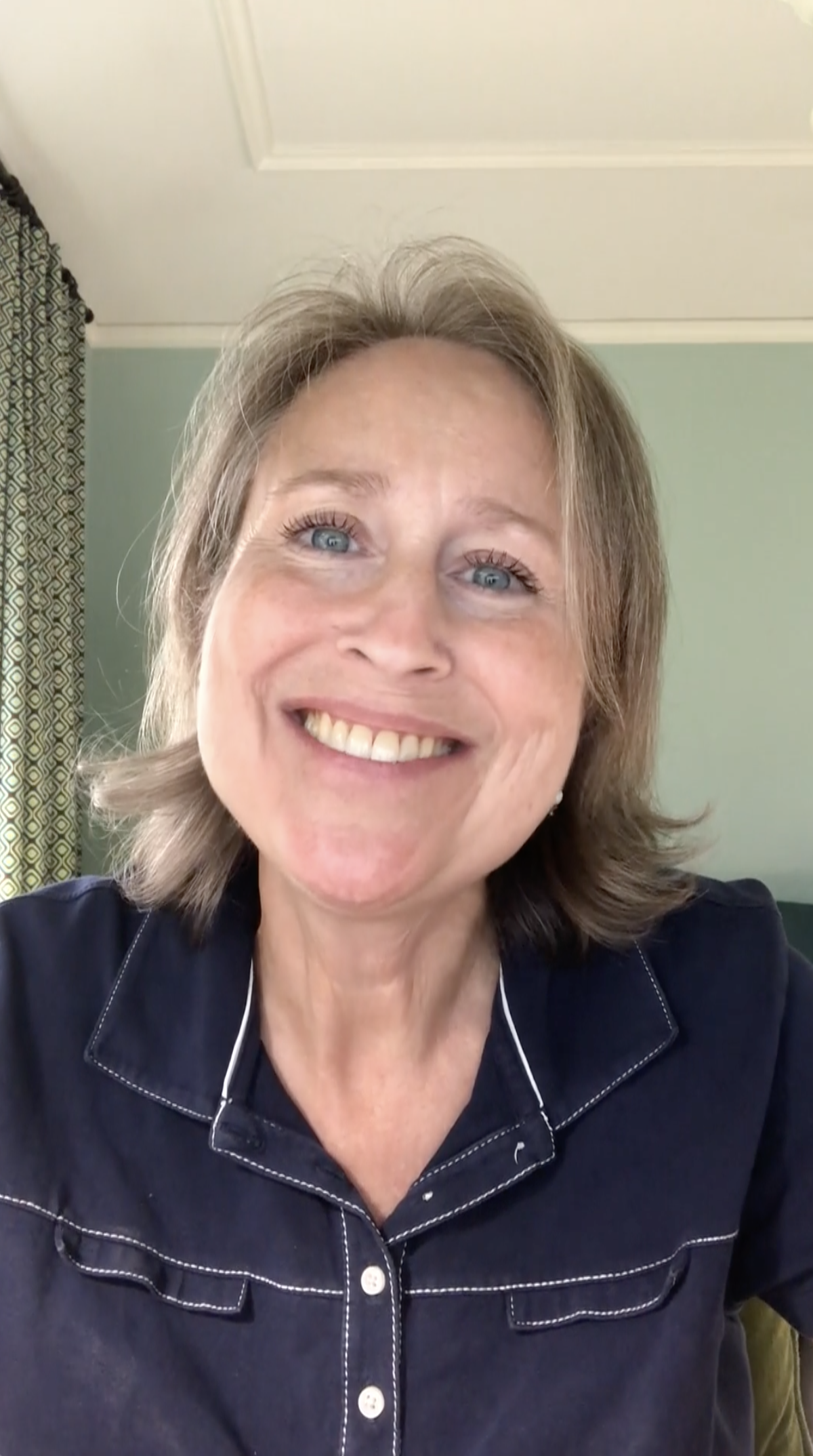
Deanna Schneider was the original Sparkly Rainbow Unicorn.
She was the girl across the street I admired when I was five—graceful, confident, a dancer—and eventually my favorite babysitter. She was also one of the first people whose energy I remember seeing clearly: rainbow-colored, sparkling, shifting like the prism stickers I collected as a child.
Deanna died in August 2025.
I think differently about that childhood memory now. At five, I didn't have a theory about what I was seeing. I didn't know anything about auras or synesthesia or energy. I only knew that there was something unusually bright about Deanna, and that I could see it.
That brightness was part of the way she moved through the world, too.
After living with cancer for many years, Deanna became an oncology navigator, helping other people find their footing inside the confusion of diagnosis, treatment, insurance, and the US healthcare system. She wrote You Are Freaking Out! Here's What to Do: A Guide to the First Days and Weeks of a Cancer Diagnosis—a practical guide for patients and the people who love them. It’s designed to provide clarity and action steps in the most overwhelming moments.
Her book remains part of what she gave to people.
But when I think of Deanna, my mind travels much farther back than that. Across the street. To the girl I admired when I was five. And to the sparkle I somehow knew enough to notice.
What We Push Away Still Finds Us
I’ve spent years balancing what I know with what I sense.
For a long time, I pushed one side away—the part of me that saw colors, felt shifts in energy, perceived things I couldn't explain. I wanted an explanation before I was willing to trust the experience.
But Deanna was there before any of the explanations. So was the pianist and the trees in Nichols Park.
Over time, the same lesson kept circling back: what we ignore doesn’t disappear, it waits until we have enough language—or enough trust—to look again.
I no longer feel the need to choose between the part of me that wants evidence and the part of me that notices what I cannot always explain. I’m interested in the space between them. That space asks for discernment, not certainty. Curiosity without credulity. Intuition without abandoning intellect.
And perhaps most of all, the willingness to notice what is actually there.
What have you been pushing away? What part of your own intuition, perception, or knowing have you explained away because it didn't fit the person you thought you were supposed to be?
You don’t have to choose between what you know and what you sense.
Intellect & Intuition is where I write about the space between them—sensitivity, perception, healing, creativity, grief, and the strange, ordinary work of learning to trust yourself.
References & Further Reading
Acevedo, B. P., Aron, E. N., Aron, A., Sangster, M.-D., Collins, N., & Brown, L. L. (2014). The highly sensitive brain: An fMRI study of sensory processing sensitivity and response to others’ emotions. Brain and Behavior, 4(4), 580–594. https://doi.org/10.1002/brb3.242
Funk, R. H. W., & Scholkmann, F. (2023). The significance of bioelectricity on all levels of organization of an organism. Part 1: From the subcellular level to cells. Progress in Biophysics and Molecular Biology, 177, 185–201. https://doi.org/10.1016/j.pbiomolbio.2022.12.002
Greven, C. U., Lionetti, F., Booth, C., Aron, E. N., Fox, E., Schendan, H. E., Pluess, M., Bruining, H., Acevedo, B., Bijttebier, P., & Homberg, J. (2019). Sensory Processing Sensitivity in the context of Environmental Sensitivity: A critical review and development of research agenda. Neuroscience & Biobehavioral Reviews, 98, 287–305. https://doi.org/10.1016/j.neubiorev.2019.01.009
Greven, C. U., Trupp, M. D., Homberg, J. R., & Slagter, H. A. (2026). Sensory processing sensitivity: Theory, evidence, and directions. Trends in Cognitive Sciences, 30(6), 530–545. https://doi.org/10.1016/j.tics.2025.10.007
Levin, M. (2021). Bioelectric signaling as a unique regulator of development and regeneration. Development, 148. https://doi.org/10.1242/dev.180794
Milán, E. G., Iborra, O., Hochel, M., Rodríguez Artacho, M. A., Delgado-Pastor, L. C., Salazar, E., & González-Hernández, A. (2012). Auras in mysticism and synaesthesia: A comparison. Consciousness and Cognition, 21(1), 258–268. https://doi.org/10.1016/j.concog.2011.11.010